Where does
your tax money
actually go?
Every euro the Dutch government moves — from EU contributions to municipal tenders. Civil servants, external hires, the companies that win the contracts. Searchable, traceable to the source.
Na 112 dagen staat de Tweede Kamer al op 1.588 moties. Op dit tempo: ~5.175 over heel 2026, ruim boven het 2022-record van 4.146.
Read the piece →
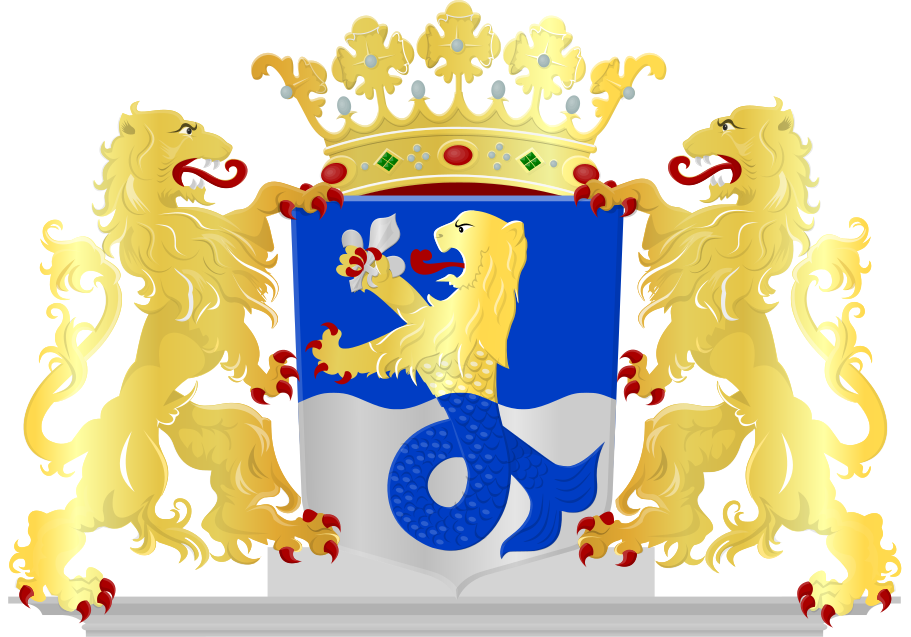

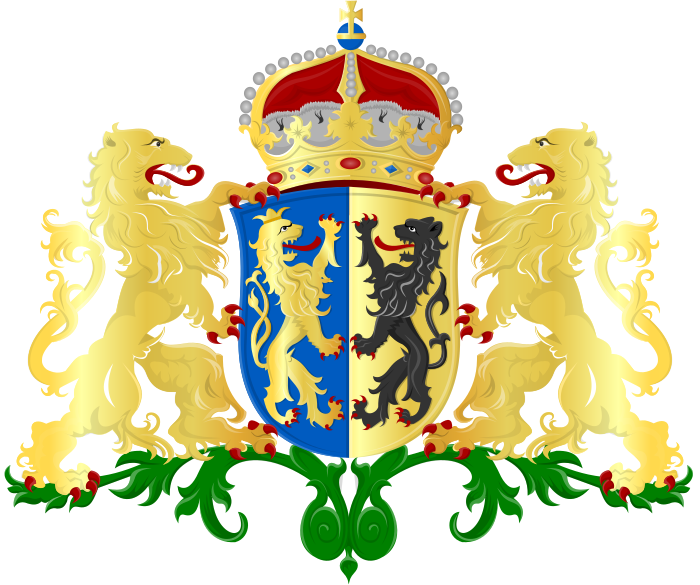



Klik een provincie voor begroting, FTE, inhuur-ratio en gegunde aanbestedingen.
Om één overheidseuro te volgen heb je drie vragen: waar (welke bestuurslaag) · wie (welke uitvoeringsvorm) · wat (welke geldstroom). Deze drie assen staan los van elkaar — een ZBO kan aanbestedingen uitzetten, een gemeente kan subsidies ontvangen, sociale fondsen worden gevuld via het Rijk.
EU contribution + Horizon, ESF, Erasmus+ → Netherlands.
15 ministries + High Councils of State + funds.
Spatial planning, public transport, nature, environmental permits.
Social support, youth care, work participation, public space.
Dykes, water levels, treatment plants. Own taxes + elections.
Arrows show geographic containment, not money flow. The Municipalities Fund (€45 bn) and Provinces Fund (€3 bn) flow directly from central government; provinces are not in the cash path to municipalities, but they do supervise municipal budgets and set spatial planning frameworks. Water authorities raise their own taxes and cut across provincial and municipal borders.
Core department — policy-making + political accountability.
Tax authority, planning bureaus, labour inspectorate — own DG, no separate legal entity.
Government real-estate, RIVM, KNMI, prison service — profit-and-loss accounting.
Social-insurance bank, central bank, land registry, statistics bureau — own legal entity and board.
Competition, financial markets, central bank, data-protection authority, ombudsman — independent of the minister they regulate.
Parliament, Council of State, Court of Audit, Ombudsman — constitutionally distinct.
Council for the Judiciary, public prosecutor, 11 district courts, 4 courts of appeal, Supreme Court — the third branch of state.
The order reflects increasing autonomy from the minister: a ministry is 100% politically directed, a High Council of State cannot be instructed by a minister. Regulators are legally ZBOs or High Councils, but listed separately because their role (market regulation, data privacy, complaints) requires distance from politics. The judiciary is not an executive body but a separate branch of state in the trias politica — off-axis. Amounts overlap: the €180 bn at ZBOs is largely contained in the €374 bn of Ministries (state contributions to SVB/UWV that flow through the funds). Don't add them up.
Old-age pension, disability, unemployment, child benefits — premiums + state contribution, via SVB/UWV.
Municipalities, climate, mobility, delta and defence-equipment fund.
Procurement via TenderNed — companies win contracts.
SDE++ energy, cultural funding, applied-research, NWO, ODA — policy-goal support.
Who ultimately gets it? Subsidies + tenders aggregated per recipient.
rijksfinancien.nl open data: 29 hoofdstukken, artikelen, ZBO's en agentschappen in Beeld.
Wekelijkse refresh uit Open Contracting Data Standard. Buyer-mapping naar Rijk / provincie / gemeente.
Jaarrapportage Bedrijfsvoering Rijk + A&O-fonds provincies/gemeenten voor ambtelijke cijfers.
Programmabegrotingen per gemeente, pdftotext-extractie. Altijd gelinkt naar de originele PDF.
Niet gelieerd aan de Rijksoverheid, VNG of IPO. Alle data is vrij her-bruikbaar onder CC0 licentie. Zie de API documentatie voor programmatische toegang.